Vallabhbhai Jhaverbhai Patel (
Hindi pronunciation: [ʋəlləbˈbʱaːi pəˈʈeːl], 31 October 1875 – 15 December 1950) was an Indian
barrister and statesman, one of the leaders of the
Indian National Congress and one of the founding fathers of the
Republic of India. He was a social leader who played a leading role in the country's
struggle for independence and guided its
integration into a united, independent nation. In India and elsewhere, he was often addressed as
Sardar,
[1] which means
Chief in
Hindi,
Urdu and Persian.
He was raised in the countryside of
Gujarat.
[2] Patel was employed in successful practice as a lawyer. He subsequently organised peasants from
Kheda,
Borsad, and
Bardoli in Gujarat in
non-violent civil disobedience against oppressive policies imposed by the
British Raj; in this role, he became one of the most influential leaders in Gujarat. He rose to the leadership of the
Indian National Congress, in which capacity he would organise the party for the elections held in 1934 and 1937, as well as continue to promote the
Quit India Movement.
As the first
Home Minister and
Deputy Prime Minister of India, Patel organised relief for
refugees fleeing from
Punjab and
Delhi
and led efforts to restore peace across the nation. Patel took charge
of the task to forge a united India by integrating into the newly
liberated nation those
British colonial provinces "allocated" to India. Besides those provinces under direct British rule, approximately 565 self-governing
princely states had been released from British
suzerainty by the
Indian Independence Act 1947.
Through both frank diplomacy as well an option to deploy military
force, Patel would persuade almost every princely state to accede to
India. Patel's commitment to national integration in the newly-liberated
country was total and uncompromising, earning him the sobriquet "Iron
Man of India". He is also affectionately remembered as the "Patron saint
of India's civil servants" for having established the
modern all-India services system.
An annual commemoration of Patel, known as the
Rashtriya Ekta Diwas (National Unity Day), was introduced by the Government of India in 2014 and is to be held annually on his birthday, 31 October.
Early life
The date of birth of Vallabhbhai Patel was never officially
recorded – Patel entered 31 October as his date of birth on his
matriculation examination papers.
[3]
Patel travelled to attend schools in
Nadiad,
Petlad and
Borsad, living self-sufficiently with other boys. He reputedly cultivated a
stoic character. A popular anecdote recounts how he lanced his own painful
boil without hesitation, even as the barber supposed to do it trembled.
[4] Patel passed his
matriculation
at the relatively late age of 22; at this point, he was generally
regarded by his elders as an unambitious man destined for a commonplace
job. Patel himself, though, harboured a plan to study to become a
lawyer, work and save funds, travel to England and study to become a
barrister.
[5]
Patel spent years away from his family, studying on his own with books
borrowed from other lawyers, passing his examinations within two years.
Fetching Jhaverba from his parents' home, Patel set up his household in
Godhra and was
called to the bar.
During the many years it took him to save money, Patel – now an
advocate – earned a reputation as a fierce and skilled lawyer. The
couple had a daughter,
Maniben, in 1904, and a son,
Dahyabhai, in 1906. Patel also cared for a friend suffering from
Bubonic plague
when it swept across Gujarat. When Patel himself came down with the
disease, he immediately sent his family to safety, left his home and
moved into an isolated house in Nadiad (by other accounts, Patel spent
this time in a dilapidated temple); there, he recovered slowly.
[6]
Patel practised law in
Godhra,
Borsad and
Anand
while taking on the financial burdens of his homestead in Karamsad.
Patel was the first chairman and founder of the E.M.H.S. "Edward
Memorial High School" Borsad, presently known as Jhaverbhai Dajibhai
Patel High School. When he had saved enough for England and applied for a
pass and a ticket, they arrived in the name of "V. J. Patel," at
Vithalbhai's home, who bore the same initials. Having once nurtured a
similar hope to study in England, Vithalbhai remonstrated to his younger
brother that it would be disreputable for an older brother to follow
his younger brother. In keeping with concerns for his family's honour,
Patel allowed Vithalbhai to go in his place.
[7]
In 1909, Patel's wife Jhaverba was hospitalised in Bombay (now
Mumbai)
to undergo a major surgical operation for cancer. Her health suddenly
worsened and, despite successful emergency surgery, she died in the
hospital. Patel was given a note informing him of his wife's demise as
he was cross-examining a witness in court. According to others who
witnessed, Patel read the note, pocketed it and continued to intensely
cross-examine the witness and won the case. He broke the news to others
only after the proceedings had ended.
[8]
Patel decided against marrying again. He raised his children with the
help of his family and sent them to English-medium schools in Mumbai. At
the age of 36, he journeyed to England and enrolled at the
Middle Temple Inn in London. Finishing a 36-month course in 30 months, Patel topped his class despite having no previous college background.
Returning to India, Patel settled in the city of
Ahmedabad
and became one of the city's most successful barristers. Wearing
European-style clothes and urbane mannerisms, he became a skilled
bridge
player. Patel nurtured ambitions to expand his practice and accumulate
great wealth and to provide his children with a modern education. He had
made a pact with his brother Vithalbhai to support his entry into
politics in the
Bombay Presidency, while Patel remained in Ahmedabad to provide for the family.
[9]
He was a vegetarian.
[10]
Fight for independence
At the urging of his friends, Patel won an election to become the
sanitation commissioner of Ahmedabad in 1917. While often clashing with
British officials on civic issues, he did not show any interest in
politics. Upon hearing of
Mohandas Gandhi, he joked to
Mavlankar that "Gandhi would ask you if you know how to sift pebbles from wheat. And that is supposed to bring independence."
[11]
Patel gave a speech in Borsad in September 1917, encouraging Indians nationwide to sign Gandhi's petition demanding
Swaraj—independence—from Britain. Meeting Gandhi a month later at the Gujarat Political Conference in
Godhra, Patel became the secretary of the
Gujarat Sabha—a public body which would become the Gujarati arm of the
Indian National Congress—at Gandhi's encouragement. Patel now energetically fought against
veth – the forced servitude of Indians to Europeans – and organised relief efforts in wake of
plague and
famine in
Kheda.
[12]
The Kheda peasants' plea for exemption from taxation had been turned
down by British authorities. Gandhi endorsed waging a struggle there,
but could not lead it himself due to his activities in
Champaran.
When Gandhi asked for a Gujarati activist to devote himself completely
to the assignment, Patel volunteered, much to Gandhi's delight.
[13]
Though his decision was made on the spot, Patel later said that his
desire and commitment came after intensive personal contemplation, as he
realised he would have to abandon his career and material ambitions.
[14]
Satyagraha in Gujarat
Supported by Congress volunteers
Narhari Parikh,
Mohanlal Pandya and
Abbas Tyabji,
Vallabhbhai Patel began a village-by-village tour in the Kheda
district, documenting grievances and asking villagers for their support
for a statewide revolt by
refusing the payment of taxes.
Patel emphasised potential hardships with the need for complete unity
and non-violence despite any provocation. He received enthusiastic
responses from virtually every village.
[15]
When the revolt was launched and revenue refused, the government sent
police and intimidation squads to seize property, including confiscating
barn animals and whole farms. Patel organised a network of volunteers
to work with individual villages – helping them hide valuables and
protect themselves during raids. Thousands of activists and farmers were
arrested, but Patel was not. The revolt began evoking sympathy and
admiration across India, including with pro-British Indian politicians.
The government agreed to negotiate with Patel and decided to suspend the
payment of revenue for the year, even scaling back the rate. Patel
emerged as a hero to Gujaratis and admired across India.
[16] In 1920, he was elected president of the newly formed
Gujarat Pradesh Congress Committee—he would serve as its president till 1945.
Patel supported Gandhi's
Non-Cooperation movement and toured the state to recruit more than 300,000 members and raise over Rs. 1.5 million in funds.
[17]
Helping organise bonfires of British goods in Ahmedabad, Patel threw in
all his English-style clothes. With his daughter Mani and son Dahya, he
switched completely to wearing
khadi. Patel also supported Gandhi's controversial suspension of resistance in wake of the
Chauri Chaura incident. He worked extensively in the following years in Gujarat against alcoholism,
untouchability and
caste discrimination, as well as for the empowerment of women. In the Congress, he was a resolute supporter of Gandhi against his
Swarajist
critics. Patel was elected Ahmedabad's municipal president in 1922,
1924 and 1927—during his terms, Ahmedabad was extended a major supply of
electricity and the school system underwent major reforms. Drainage and
sanitation systems were extended over all the city. He fought for the
recognition and payment of teachers employed in schools established by
nationalists (out of British control) and even took on sensitive Hindu-
Muslim Issues.
[18]
Patel personally led relief efforts in the aftermath of the intense
torrential rainfall in 1927, which had caused major floods in the city
and in the Kheda district and great destruction of life and property. He
established refuge centres across the district, raised volunteers,
arranged for supply of food, medicines and clothing, as well as
emergency funds from the government and public.
[19]
When Gandhi was in prison, Patel was asked by Members of Congress to lead the satyagraha in
Nagpur
in 1923 against a law banning the raising of the Indian flag. He
organised thousands of volunteers from all over the country in
processions hoisting the flag. Patel negotiated a settlement that
obtained the release of all prisoners and allowed nationalists to hoist
the flag in public. Later that year, Patel and his allies uncovered
evidence suggesting that the police were in league with local
dacoits
in the Borsad taluka even as the government prepared to levy a major
tax for fighting dacoits in the area. More than 6,000 villagers
assembled to hear Patel speak and supported the proposed agitation
against the tax, which was deemed immoral and unnecessary. He organised
hundreds of Congressmen, sent instructions and received information from
across the district. Every village in the
taluka
resisted payment of the tax, and through cohesion, also prevented the
seizure of property and lands. After a protracted struggle, the
government withdrew the tax. Historians believe that one of Patel's key
achievements was the building of cohesion and trust amongst the
different castes and communities, which were divided on socio-economic
lines.
[20]
In April 1928, Patel returned to the independence struggle from his
municipal duties in Ahmedabad when Bardoli suffered from a serious
predicament of a famine and steep tax hike. The revenue hike was steeper
than it had been in Kheda even though the famine covered a large
portion of Gujarat. After cross-examining and talking to village
representatives, emphasising the potential hardship and need for
non-violence and cohesion, Patel initiated the struggle—complete denial
of taxes.
[21]
Patel organised volunteers, camps and an information network across
affected areas. The revenue refusal was stronger than in Kheda and many
sympathy satyagrahas were undertaken across Gujarat. Despite arrests,
seizures of property and lands, the struggle intensified. The situation
reached a head in August, when through sympathetic intermediaries, he
negotiated a settlement repealing the tax hike, reinstating village
officials who had resigned in protest and the return of seized property
and lands. It was during the struggle and after the victory in Bardoli
that Patel was increasingly addressed by his colleagues and followers as
Sardar.
[22]
As Gandhi embarked on the
Dandi Salt March, Patel was arrested in the village of Ras and was put on trial without
witnesses, with no lawyer or pressman allowed to attend. Patel's arrest and Gandhi's subsequent arrest caused the
Salt Satyagraha
to greatly intensify in Gujarat—districts across Gujarat launched an
anti-tax rebellion until and unless Patel and Gandhi were released.
[23]
Once released, Patel served as interim Congress president, but was
re-arrested while leading a procession in Mumbai. After the signing of
the
Gandhi-Irwin Pact, Patel was elected Congress president for its 1931 session in
Karachi—here
the Congress ratified the pact, committed itself to the defence of
fundamental rights and human freedoms, and a vision of a secular nation,
minimum wage and the abolition of untouchability and serfdom. Patel
used his position as Congress president in organising the return of
confiscated lands to farmers in Gujarat.
[24] Upon the failure of the
Round Table Conference
in London, Gandhi and Patel were arrested in January 1932 when the
struggle re-opened, and imprisoned in the Yeravda Central Jail. During
this term of imprisonment, Patel and Gandhi grew close to each other,
and the two developed a close bond of affection, trust, and frankness.
Their mutual relationship could be described as that of an elder brother
(Gandhi) and his younger brother (Patel). Despite having arguments with
Gandhi, Patel respected his instincts and leadership. During
imprisonment, the two would discuss national and social issues, read
Hindu epics and crack jokes. Gandhi also taught Patel
Sanskrit language. Gandhi's secretary
Mahadev Desai kept detailed records of conversations between Gandhi and Patel.
[25]
When Gandhi embarked on a fast-unto-death protesting the separate
electorates allocated for untouchables, Patel looked after Gandhi
closely and himself refrained from partaking of food.
[26] Patel was later moved to a jail in
Nasik,
and refused a British offer for a brief release to attend the cremation
of his brother Vithalbhai, who had died in 1934. He was finally
released in July of the same year.
Patel's position at the highest level in the
Congress was largely connected with his role from 1934 onwards (when the Congress abandoned its
boycott of elections) in the party organisation. Based at an apartment in
Mumbai,
he became the Congress's main fund-raiser and chairman of its Central
Parliamentary Board, playing the leading role in selecting and financing
candidates for the 1934 elections to the
Central Legislative Assembly in New Delhi and also for the Provincial elections of 1936.
[27] As well as collecting funds and selecting candidates, he would also determine the Congress stance on issues and opponents.
[28]
Not contesting a seat for himself, Patel nevertheless guided
Congressmen elected in the provinces and at the national level. In 1935,
Patel underwent surgery for
haemorrhoids,
yet guided efforts against plague in Bardoli and again when a drought
struck Gujarat in 1939. Patel would guide the Congress ministries that
had won power across India with the aim of preserving party
discipline—Patel feared that the British would use opportunities to
create conflicts among elected Congressmen, and he did not want the
party to be distracted from the goal of complete independence.
[29] But Patel would clash with
Nehru,
opposing declarations of the adoption of socialism at the 1936 Congress
session, which he believed was a diversion from the main goal of
achieving independence. In 1938, Patel organised rank and file
opposition to the attempts of then-Congress president
Subhas Chandra Bose
to move away from Gandhi's principles of non-violent resistance. Patel
considered Bose to want more power over the party. He led senior
Congress leaders in a protest, which resulted in Bose's resignation. But
criticism arose from Bose's supporters, socialists and other
Congressmen that Patel himself was acting in an authoritarian manner in
his defence of Gandhi's authority.
Quit India
On the outbreak of World War II Patel supported Nehru's decision to
withdraw the Congress from central and provincial legislatures, contrary
to Gandhi's advice, as well as an initiative by senior leader
Chakravarthi Rajagopalachari
to offer Congress's full support to Britain if it promised Indian
independence at the end of the war and install a democratic government
right away. Gandhi had refused to support Britain on the grounds of his
moral opposition to war, while
Subhas Chandra Bose
was in militant opposition to the British. The British rejected
Rajagopalachari's initiative, and Patel embraced Gandhi's leadership
again.
[30]
He participated in Gandhi's call for individual disobedience, and was
arrested in 1940 and imprisoned for nine months. He also opposed the
proposals of the
Cripps' mission in 1942. Patel lost more than twenty pounds during his period in jail.
While Nehru, Rajagopalachari and
Maulana Azad initially criticised Gandhi's proposal for an all-out campaign of civil disobedience to force the British to
Quit India, Patel was its most fervent supporter. Arguing that the British would retreat from India as they had from Singapore and
Burma, Patel stressed that the campaign start without any delay.
[31]
Though feeling that the British would not quit immediately, Patel
favoured an all-out rebellion which would galvanise Indian people, who
had been divided in their response to the war, In Patel's view, an
all-out rebellion would force the British to concede that continuation
of colonial rule had no support in India, and thus speed power transfer
to Indians.
[32]
Believing strongly in the need for revolt, Patel stated his intention
to resign from the Congress if the revolt was not approved.
[33] Gandhi strongly pressured the
All India Congress Committee
to approve of an all-out campaign of civil disobedience, and the AICC
approved the campaign on 7 August 1942. Though Patel's health had
suffered during his stint in jail, Patel gave emotional speeches to
large crowds across India,
[34]
asking people to refuse paying taxes and participate in civil
disobedience, mass protests and a shutdown of all civil services. He
raised funds and prepared a second-tier of command as a precaution
against the arrest of national leaders.
[35] Patel made a climactic speech to more than 100,000 people gathered at
Gowalia Tank in Bombay (Mumbai) on 7 August:
The Governor of Burma
boasts in London that they left Burma only after reducing everything to
dust. So you promise the same thing to India? ... You refer in your
radio broadcasts and newspapers to the government established in Burma
by Japan as a puppet government? What sort of government do you have in
Delhi now?...When France fell before the Nazi onslaught, in the midst of
total war, Mr. Churchill offered union with England to the French. That
was indeed a stroke of inspired statesmanship. But when it comes to
India? Oh no! Constitutional changes in the midst of a war? Absolutely
unthinkable ... The object this time is to free India before the
Japanese can come and be ready to fight them if they come. They will
round up the leaders, round up all. Then it will be the duty of every
Indian to put forth his utmost effort—within non-violence. No source is
to be left untapped; no weapon untried. This is going to be the
opportunity of a lifetime.[36]
Historians believe that Patel's speech was instrumental in
electrifying nationalists, who had been sceptical of the proposed
rebellion. Patel's organising work in this period is credited by
historians for ensuring the success of the rebellion across India.
[37] Patel was arrested on 9 August and was imprisoned with the entire
Congress Working Committee from 1942 to 1945 at the fort in
Ahmednagar.
Here he spun cloth, played bridge, read a large number of books, took
long walks, practised gardening. He also provided emotional support to
his colleagues while awaiting news and developments of the outside.
[38] Patel was deeply pained at the news of the deaths of Mahadev Desai and
Kasturba Gandhi later in the year.
[39]
But Patel wrote in a letter to his daughter that he and his colleagues
were experiencing "fullest peace" for having done "their duty."
[40]
Even though other political parties had opposed the struggle and the
British had employed ruthless means of suppression, the Quit India
movement was "by far the most serious rebellion since that of 1857," as
the viceroy cabled to
Winston Churchill.
More than 100,000 people were arrested and many were killed in violence
with the police. Strikes, protests and other revolutionary activities
had broken out across India.
[41]
When Patel was released on 15 June 1945 he realised that the British
were preparing proposals to transfer power to Indian hands.
[42]
in organising relief and emergency
supplies, establishing refugee camps and visiting the border areas with
Pakistani leaders to encourage peace. Despite these efforts, the death
toll is estimated at between 500,000 to 1 million people.
[45] The estimated number of refugees in both countries exceeds 15 million.
[46]
Understanding that Delhi and Punjab policemen, accused of organising
attacks on Muslims, were personally affected by the tragedies of
partition, Patel called out the
Indian Army with South Indian regiments to restore order, imposing strict curfews and shoot-at-sight orders. Visiting the
Nizamuddin Auliya Dargah
area in Delhi, where thousands of Delhi Muslims feared attacks, he
prayed at the shrine, visited the people and reinforced the presence of
police. He suppressed from the press reports of atrocities in Pakistan
against Hindus and
Sikhs to prevent retaliatory violence. Establishing the
Delhi Emergency Committee
to restore order and organising relief efforts for refugees in the
capital, Patel publicly warned officials against partiality and neglect.
When reports reached Patel that large groups of Sikhs were preparing to
attack Muslim convoys heading for Pakistan, Patel hurried to
Amritsar
and met Sikh and Hindu leaders. Arguing that attacking helpless people
was cowardly and dishonourable, Patel emphasised that Sikh actions would
result in further attacks against Hindus and Sikhs in Pakistan. He
assured the community leaders that if they worked to establish peace and
order and guarantee the safety of Muslims, the Indian government would
react forcefully to any failures of Pakistan to do the same.
Additionally, Patel addressed a massive crowd of approximately 200,000
refugees who had surrounded his car after the meetings:
Here, in this same city, the blood of Hindus, Sikhs and Muslims mingled in the bloodbath of Jallianwala Bagh.
I am grieved to think that things have come to such a pass that no
Muslim can go about in Amritsar and no Hindu or Sikh can even think of
living in Lahore. The butchery of innocent and defenceless men, women
and children does not behove brave men ... I am quite certain that
India's interest lies in getting all her men and women across the border
and sending out all Muslims from East Punjab. I have come to you with a
specific appeal. Pledge the safety of Muslim refugees crossing the
city. Any obstacles or hindrances will only worsen the plight of our
refugees who are already performing prodigious feats of endurance. If we
have to fight, we must fight clean. Such a fight must await an
appropriate time and conditions and you must be watchful in choosing
your ground. To fight against the refugees is no fight at all. No laws
of humanity or war among honourable men permit the murder of people who
have sought shelter and protection. Let there be truce for three months
in which both sides can exchange their refugees. This sort of truce is
permitted even by laws of war. Let us take the initiative in breaking
this vicious circle of attacks and counter-attacks. Hold your hands for a
week and see what happens. Make way for the refugees with your own
force of volunteers and let them deliver the refugees safely at our
frontier.[47]
Following his dialogue with community leaders and his speech, no
further attacks occurred against Muslim refugees, and a wider peace and
order was re-established soon over the entire area. However, Patel was
criticised by Nehru, secular Muslims and taxed by Gandhi over his
alleged wish to see Muslims from other parts of India depart. While
Patel vehemently denied such allegations, the acrimony with
Maulana Azad
and other secular Muslim leaders increased when Patel refused to
dismiss Delhi's Sikh police commissioner, who was accused of
discrimination. Hindu and Sikh leaders also accused Patel and other
leaders of not taking Pakistan sufficiently to task over the attacks on
their communities there, and Muslim leaders further criticised him for
allegedly neglecting the needs of Muslims leaving for Pakistan, and
concentrating resources for incoming Hindu and Sikh refugees. Patel
clashed with Nehru and Azad over the allocation of houses in Delhi
vacated by Muslims leaving for Pakistan—Nehru and Azad desired to
allocate them for displaced Muslims, while Patel argued that no
government professing
secularism
must make such exclusions. However, Patel was publicly defended by
Gandhi and received widespread admiration and support for speaking
frankly on communal issues and acting decisively and resourcefully to
quell disorder and violence.
Political integration of India
This event formed the cornerstone of Patel's popularity in
post-independence era and even today, he is remembered as the man who
united India. He is, in this regard, compared to
Otto von Bismarck
of Germany, who did the same thing in 1860s. Under the plan of 3 June,
more than 562 princely states were given the option of joining either
India or Pakistan, or choosing independence. Indian nationalists and
large segments of the public feared that if these states did not accede,
most of the people and territory would be fragmented. The Congress as
well as senior British officials considered Patel the best man for the
task of achieving unification of the princely states with the Indian
dominion. Gandhi had said to Patel
"the problem of the States is so difficult that you alone can solve it".[48] He was considered a statesman of integrity with the practical acumen and resolve to accomplish a monumental task. Patel asked
V. P. Menon, a senior civil servant with whom he had worked over the
partition of India,
to become his right-hand as chief secretary of the States Ministry. On 6
May 1947, Patel began lobbying the princes, attempting to make them
receptive towards dialogue with the future Government and trying to
forestall potential conflicts. Patel used social meetings and unofficial
surroundings to engage most monarchs, inviting them to lunch and tea at
his home in
Delhi.
At these meetings, Patel stated that there was no inherent conflict
between the Congress and the princely order. Nonetheless, he stressed
that the princes would need to accede to India in good faith by 15
August 1947. Patel invoked the patriotism of India's monarchs, asking
them to join in the freedom of their nation and act as responsible
rulers who cared about the future of their people. He persuaded the
princes of 565 states of the impossibility of independence from the
Indian republic, especially in the presence of growing opposition from
their subjects. He proposed favourable terms for the merger, including
creation of
privy purses
for the descendants of the rulers. While encouraging the rulers to act
with patriotism, Patel did not rule out force, setting a deadline of 15
August 1947 for them to sign the instrument of accession document. All
but three of the states willingly merged into the Indian union—only
Jammu and Kashmir,
Junagadh, and
Hyderabad did not fall into his basket.
Somnath temple ruins, 1869
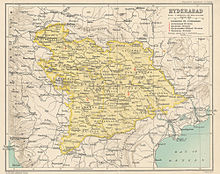
Hyderabad state in 1909. Its area stretched over large parts of the current Indian states of
Telangana Karnataka, Maharashtra.
Junagadh was especially important to Patel, since it was in his home state of
Gujarat
and also because this Kathiawar district had the ultra-rich Somnath
temple which had been plundered 17 times by Mahmud of Ghazni who broke
the temple and its idols to rob it of its riches, emeralds, diamonds and
gold. The Nawab had under pressure from Sir
Shah Nawaz Bhutto
acceded to Pakistan. It was however, quite far from Pakistan and 80% of
its population was Hindu. Patel combined diplomacy with force,
demanding that Pakistan annul the accession, and that the Nawab accede
to India. He sent the Army to occupy three principalities of Junagadh to
show his resolve. Following widespread protests and the formation of a
civil government, or
Aarzi Hukumat, both Bhutto and the Nawab fled to
Karachi,
and under Patel's orders, Indian Army and police units marched into the
state. A plebiscite later organised produced a 99.5% vote for merger
with India.
[49]
In a speech at the Bahauddin College in Junagadh following the latter's
take-over, Patel emphasised his feeling of urgency on Hyderabad, which
he felt was more vital to India than Kashmir:
If Hyderabad does not see the
writing on the wall, it goes the way Junagadh has gone. Pakistan
attempted to set off Kashmir against Junagadh. When we raised the
question of settlement in a democratic way, they (Pakistan) at once told
us that they would consider it if we applied that policy to Kashmir.
Our reply was that we would agree to Kashmir if they agreed to
Hyderabad.
[49]
Hyderabad was the largest of the princely states, and included parts of present day
Telangana,
Karnataka, and
Maharashtra states. Its ruler, the
Nizam Osman Ali Khan
was a Muslim, although over 80% of its people were Hindu. The Nizam
sought independence or accession with Pakistan. Muslim forces loyal to
Nizam, called the
Razakars, under
Qasim Razvi
pressed the Nizam to hold out against India, while organising attacks
on people on Indian soil. Even though a Standstill Agreement was signed
due to the desperate efforts of Lord Mountbatten to avoid a war, the
Nizam rejected deals and changed his positions.
[50]
In September 1948, Patel emphasised in Cabinet meetings that India
should talk no more, and reconciled Nehru and the Governor-General,
Chakravarti Rajgopalachari to military action. Following preparations, Patel ordered the
Indian Army to integrate Hyderabad (in his capacity as Acting Prime Minister) when Nehru was touring Europe.
[51] The action was termed
Operation Polo,
in which thousands of Razakar forces had been killed, but Hyderabad was
comfortably secured into the Indian Union. The main aim of Mountbatten
and Nehru in avoiding a forced annexation was to prevent an outbreak of
Hindu-Muslim violence. Patel insisted that if Hyderabad was allowed to
continue with its antics, the prestige of the Government would fall and
then neither Hindus nor Muslims would feel secure in its realm. After
defeating Nizam, Patel retained him as the ceremonial chief of state,
and held talks with him.
[52]


